5 Red Flags That Kill Deals in Technical Due Diligence
TL;DR
- Technical debt, key person risk, and security gaps are the red flags that kill deal valuations — and acquirers know exactly where to look
- 53% of dealmakers discover major cyber issues only after closing — by then, you’ve already lost leverage
- Every red flag is fixable, but remediation takes 6-18 months — not 6 weeks before a deal
- A fractional CTO paired with AI dev tools can compress that timeline from years to months
83% of M&A deals fail to boost shareholder returns. That’s a staggering number. And while there are plenty of reasons deals go sideways — cultural mismatch, overvalued synergies, integration failures — technology problems are increasingly at the top of the list.
As a fractional CTO, I see these same red flags in company after company. They’re not exotic. They’re not surprises. They’re the predictable patterns that acquirers have learned to spot in the first week of due diligence.
The good news? Every one of them is fixable. But only if you know what buyers are looking for — and you start early enough to do something about it.
Why technology due diligence matters more than ever
Your technology is going to be audited. The question is whether you’re ready.
Technology isn’t just infrastructure anymore — for most mid-market companies, it IS the business. Your software, your data, your security posture — these are core assets that directly affect valuation.
Buyers have gotten sophisticated. A decade ago, tech due diligence was a checkbox. Today, acquirers bring in specialized teams that evaluate your codebase, architecture, security controls, and team structure with the same rigor they apply to your financials.
And fewer than 20% of acquirers successfully improve IT costs and quality after closing. That means buyers are pricing in your technology problems upfront. They’re not planning to fix them later — they’re discounting your valuation now.
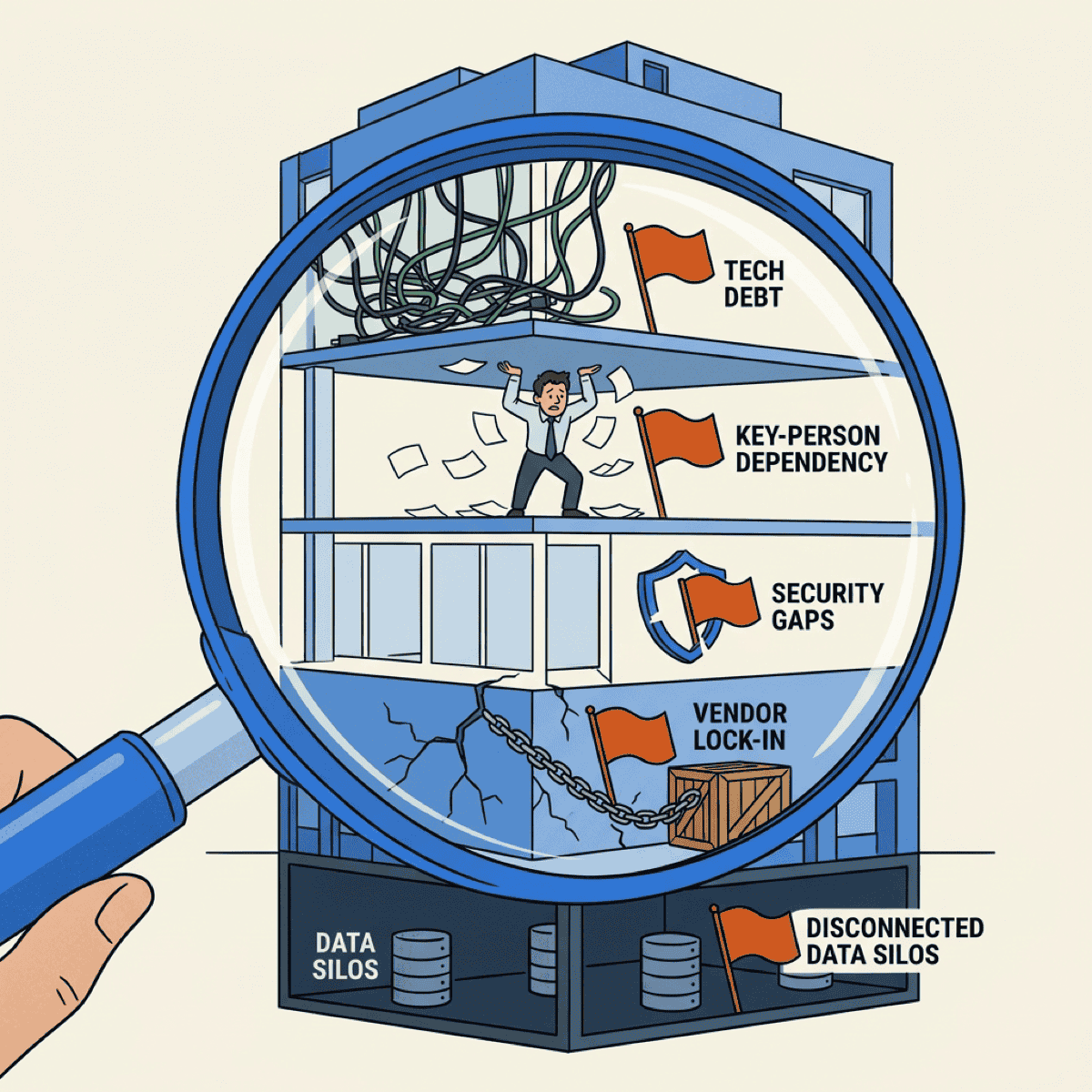
Red flag #1: Technical debt consuming the roadmap
When more than 25% of developer time goes to maintenance and firefighting instead of building new features, it signals systematic underinvestment. Acquirers see this immediately.
McKinsey estimates that tech debt represents 20-40% of the average technology estate. And 30% of CIOs report that more than 20% of their budget for new products gets diverted to resolving tech debt instead.
If your dev team can’t ship new features because they’re constantly fixing old ones, buyers see a liability, not an asset.
Red flag #2: Key person dependency and missing documentation
Critical knowledge locked in one or two people’s heads is one of the fastest ways to kill a deal. And the documentation that should capture that knowledge? It’s either missing, outdated, or both.
Valuation discounts of 10-25% are common for companies with key person risk — and that’s for public companies with some institutional structure. For private, closely held companies, the discount can be far steeper.
A “bus factor” of one means maximum risk. If your lead developer or CTO left tomorrow, could the team still ship? If the answer is no — or even “maybe” — acquirers will factor that into the price.
Then there are the “shadow integrations” — scripts and scheduled jobs that nobody remembers building but that quietly connect critical systems. Architecture diagrams that haven’t been updated in three years. API specs that don’t match actual endpoints. The only person who understands them left the company two years ago.
When critical knowledge lives in one person’s head, it doesn’t just create risk — it creates a ceiling on what the company is worth.
— Clarke Bishop
Poor documentation doesn’t just slow integration. It makes the acquirer question whether your team can operate at scale. If you can’t explain how your own systems work, why would a buyer trust that they can?
Red flag #3: Security and compliance gaps
This is where deals die.
53% of dealmakers discover significant cybersecurity issues only after a deal closes. And 73% would walk away entirely if undisclosed breaches or security issues surfaced during due diligence.
The numbers are painful. 62% of deals are delayed by cybersecurity problems. The average breach costs $4.88M — the steepest jump since the pandemic.
Missing SOC 2 certification. Gaps in HIPAA compliance. No penetration testing history. No incident response plan. Any of these alone can stall a deal — together, they signal a company that treats security as an afterthought.
Red flag #4: Architecture that can’t scale — and can’t be escaped
The demo works perfectly. The pitch deck shows beautiful dashboards. But under real-world load? The system crumbles.
No load testing evidence. No performance benchmarks. A monolithic system with no clear path to modernization. Acquirers want to grow the business — if the technology can’t grow with it, the deal loses value fast.
This gets worse when scaling problems are tangled with vendor lock-in. Your entire stack runs on one cloud provider. Your core application depends on a niche vendor’s proprietary platform. Your data lives in a format that only one tool can read.
If your critical vendor goes under, gets acquired, or raises prices 300% — what’s your plan? No source code escrow. No data portability plan. No documented exit path. Every one of these gaps is a negotiating chip for the buyer — and a discount on your valuation.
The technology that works at your current scale might be the biggest liability at the scale a buyer is planning for.
— Clarke Bishop
Red flag #5: No data governance or migration path
Data is often the most valuable asset in a deal — but only if it can be extracted, migrated, and integrated.
83% of data migration projects fail or exceed their budget. That’s not a typo. When acquirers see data silos across departments, no data dictionary, no schema documentation, and no integration plan, they’re pricing in a migration disaster.
Undocumented data relationships, inconsistent formats across systems, and no clear ownership of data quality — these problems don’t just make integration expensive. They make the acquirer question the value of the data itself.
How AI compresses the remediation timeline
Every red flag on this list is fixable. But fixing them traditionally takes 6-18 months of expensive, grinding work. That timeline is shrinking.
AI dev tools are changing what’s possible across every one of these areas:
- Technical debt: AI code analysis scans your entire codebase in hours — identifying the highest-risk debt, flagging vulnerabilities, and prioritizing fixes. AI-assisted refactoring compresses cleanup that used to take quarters into weeks
- Key person risk and documentation: AI tools reverse-engineer undocumented code into plain-language explanations, generate architecture docs and API specs directly from the codebase, and map system dependencies automatically. The backlog item nobody ever prioritized becomes a solvable problem
- Security gaps: AI-powered scanners identify vulnerabilities that manual reviews miss, map your entire attack surface, and generate compliance gap analyses for SOC 2 and HIPAA. This doesn’t replace a proper security program, but it dramatically accelerates assessment
- Architecture and vendor lock-in: AI tools analyze architecture patterns, identify scaling bottlenecks, generate load test scripts, and produce migration plans for vendor-specific dependencies. Exit strategies move from theoretical documents to executable plans
- Data governance: AI catalogs data assets across your organization, generates data dictionaries, maps schemas, and identifies relationships between silos. The tedious work nobody wants to do manually becomes automated
The critical combination is human judgment plus AI execution. You need the experience to know which red flags are deal-critical versus nice-to-have, how to prioritize when everything feels urgent, and how to communicate progress to a board or PE partner. But you need AI tools to execute at a speed that actually fits the timeline.
What to do about it
Start your tech audit 12-18 months before any potential exit. Don’t wait until a buyer is in the room. By then, you’re negotiating from weakness, and every red flag becomes a discount on your price.
Prioritize in this order:
- Security and compliance — these are deal killers, and they take the longest to remediate properly
- Key person risk and documentation — start documenting and cross-training now, before someone leaves
- Technical debt — tackle the highest-risk items first, not the most annoying ones
- Architecture, data governance, vendor lock-in — these require strategic decisions, not just execution
These red flags aren’t exotic. They’re the same patterns that show up in company after company. The companies that get the best valuations aren’t the ones with perfect technology. They’re the ones that did the work before the buyer showed up.
If you’re thinking about an exit in the next two to three years, now is the time to start. Not next quarter. Not when the LOI arrives. Now.
Want an objective assessment of your technology stack? Let’s talk about how a fractional CTO engagement can help you fix these red flags before a buyer ever looks.